BepiColombo's Mercury Arrival: How ESA and JAXA's Eight-Year Mission Reaches Its Destination
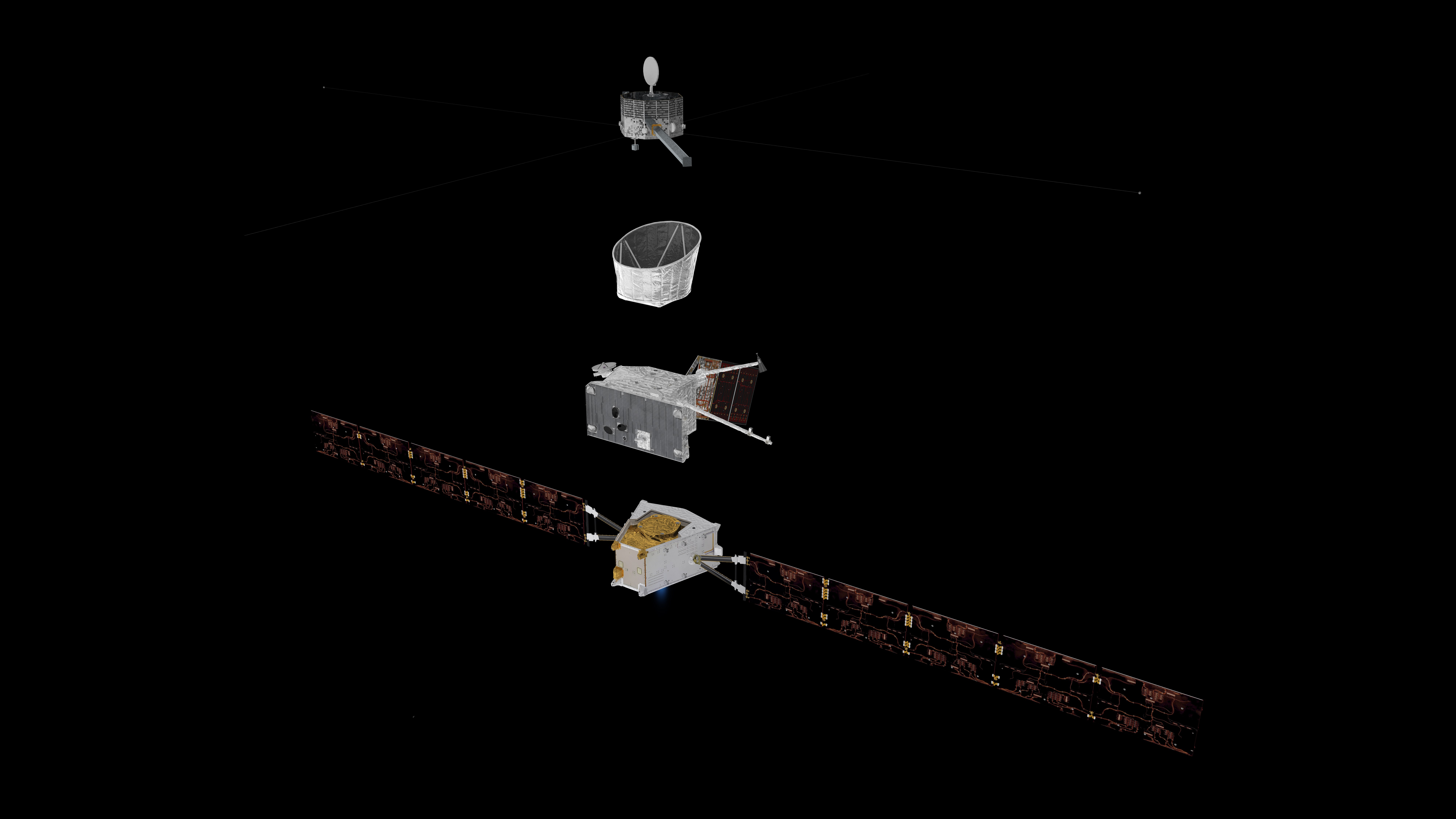 Exploded view of the BepiColombo spacecraft components. From top to bottom: JAXA’s Mercury Magnetospheric Orbiter (Mio), the MOSIF sunshield, ESA’s Mercury Planetary Orbiter (MPO), and the Mercury Transfer Module. Image: ESA (ESA Standard Licence, educational/editorial use permitted)
On September 3, 2026, at 14:00 CEST, a spacecraft 200 million kilometers from Earth executed a separation maneuver that the European Space Agency (ESA) had been preparing for months. The Mercury Transfer Module (MTM) — the workhorse that had carried BepiColombo through 9.9 billion kilometers of inner Solar System travel over nearly eight years — released its payload of two science orbiters and drifted away, its job complete. Confirmation reached ESA’s mission control in Darmstadt, Germany, at 15:49 CEST, prompting cheers from the team. BepiColombo’s arrival at Mercury had begun.
But this was not a typical planetary arrival. Unlike most missions that perform a single orbit-insertion burn and settle into their science orbit, BepiColombo faces a six-month sequence of carefully choreographed separations, maneuvers, and orbit adjustments before its two spacecraft begin collecting science data in April 2027. Here is how the mission works, what it will study, and why Mercury remains the least explored planet in the inner Solar System.
In Brief
- BepiColombo launched on October 20, 2018, on an Ariane 5 from Kourou, French Guiana, as a joint mission between ESA and JAXA.
- The Mercury Transfer Module separated from the two orbiter spacecraft on September 3, 2026, after 9.9 billion kilometers of travel and nine planetary flybys.
- Mercury orbit insertion is scheduled for November 21, 2026, followed by Mio separation on December 9–10 and MPO reaching its final orbit on March 10, 2027.
- The mission carries 16 science instruments across two orbiters, making it the first mission to operate two spacecraft around Mercury simultaneously.
- A solar array issue in April 2024 reduced available power, forcing a trajectory redesign that delayed arrival from December 2025 to November 2026.
- Science operations are expected to begin on April 6, 2027.
Why Mercury Is So Hard to Reach
Mercury is the closest planet to the Sun, but reaching it is not simply a matter of flying inward. The Sun’s gravity accelerates any spacecraft falling toward the inner Solar System, and without continuous braking, that spacecraft would overshoot Mercury and spiral into the Sun. According to ESA, this makes Mercury “more difficult to reach than Saturn” despite being far closer.
BepiColombo solved this problem with a combination of solar-electric propulsion (SEP) and gravity assists. The MTM carried four ion thrusters that used solar-generated electricity to accelerate xenon gas into plasma, expelled at 50,000 meters per second — about 15 times the exhaust velocity of conventional chemical rockets. This high efficiency allowed the mission to carry far less propellant than a chemical-only design would require, but the thrust is gentle, requiring months of continuous firing.
The trajectory also required one Earth flyby, two Venus flybys, and six Mercury flybys to gradually reduce the spacecraft’s velocity relative to Mercury. Each flyby used a planet’s gravity to reshape the orbit without burning propellant, a technique first proposed by the mission’s namesake, Italian engineer Giuseppe “Bepi” Colombo (1920–1984), who suggested the gravity-assist trajectories used by NASA’s Mariner 10 in the 1970s.
The mission was made even harder by an issue discovered in April 2024, when one of MTM’s solar arrays experienced a power reduction. ESA engineers redesigned the trajectory with lower-thrust burns, which preserved the mission but pushed the arrival from December 2025 to November 2026 — a delay of nearly a year.
The Three-Spacecraft Stack
BepiColombo is not one spacecraft but three, stacked together for the long journey to Mercury:
Mercury Transfer Module (MTM): Built by ESA, this module carried the two orbiters from Earth to Mercury. Roughly the size of a small car, it carried two 15-meter solar arrays and four ion thrusters. It had three monitoring cameras that documented the journey, capturing images of Earth, Venus, and Mercury during flybys. The MTM has no onboard computer or antenna of its own; after separation, it became an inert object that will circle the Sun indefinitely.
Mercury Planetary Orbiter (MPO): ESA’s primary science orbiter, measuring 2.4 × 2.2 × 1.7 meters with a 3.7-meter radiator and a 7.5-meter solar wing. It carries 11 science instruments and will operate from a 2.3-hour polar orbit at 480 × 1,500 kilometers altitude. The wide radiator is essential — Mercury’s surface temperatures can exceed 450°C, and the spacecraft must reject heat while flying at low altitude.
Mercury Magnetospheric Orbiter (Mio): JAXA’s orbiter, an octagonal prism 1.1 meters high and 1.8 meters in diameter. It spins at 15 rotations per minute to distribute solar heat evenly and carries five science instruments focused on Mercury’s magnetosphere and plasma environment. Mio will operate from a 9.3-hour elliptical orbit at 590 × 11,640 kilometers. During the cruise phase, it was protected by the MOSIF sunshield, which will be jettisoned after separation.
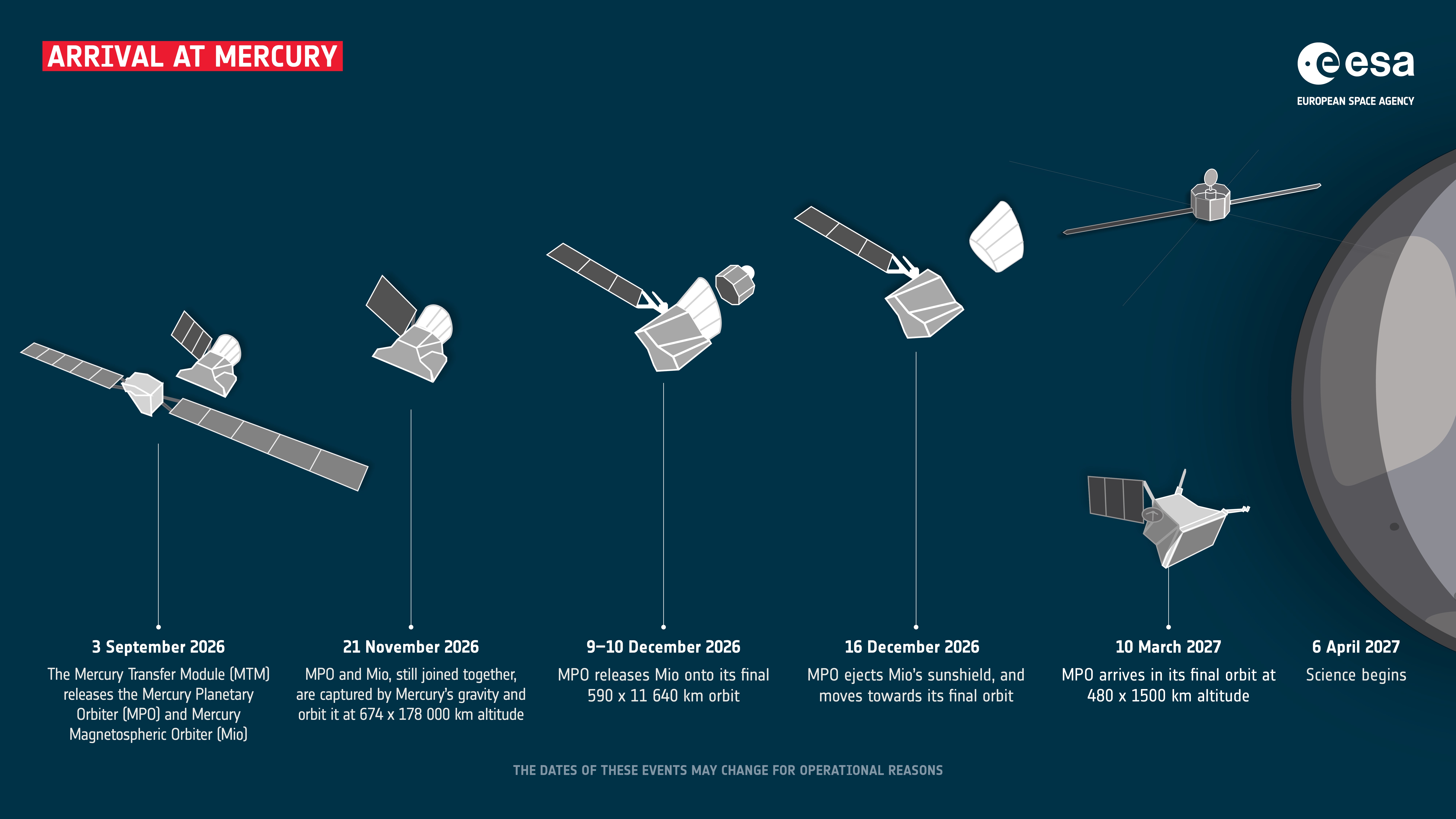 BepiColombo’s arrival sequence: MTM separation (Sep 3, 2026), Mercury orbit insertion (Nov 21, 2026), Mio separation (Dec 9–10, 2026), MOSIF jettison (Dec 16, 2026), MPO final orbit (Mar 10, 2027), science phase begins (Apr 6, 2027). Image: ESA (ESA Standard Licence, educational/editorial use permitted)
The Six-Month Arrival Sequence
Most planetary missions arrive in a single dramatic maneuver — an engine burn that captures the spacecraft into orbit. BepiColombo cannot do this because the two orbiters are stacked together and must separate at different points in the sequence.
Step 1 — MTM separation (September 3, 2026): The transfer module released the stacked MPO and Mio spacecraft. ESA’s mission control confirmed separation via a Doppler signal at 14:20 CEST, followed by full telemetry at 15:49 CEST. The remaining stack entered safe mode, reconfigured itself, and transmitted status back to Earth.
Step 2 — Mercury orbit insertion (November 21, 2026): Using MPO’s chemical propulsion system, the spacecraft will perform a capture burn to enter orbit around Mercury. This is not a single burn but the beginning of a sequence of 16 maneuvers to progressively lower and reshape the orbit.
Step 3 — Mio separation (December 9–10, 2026): MPO will release Mio into its operational elliptical orbit. After separation, Mio will spin up to 15 rpm and begin operating independently.
Step 4 — MOSIF jettison (December 16, 2026): The sunshield that protected Mio during the cruise phase will be discarded, as it is no longer needed.
Step 5 — MPO final orbit (March 10, 2027): MPO will use its thrusters to descend to its science orbit at 480 × 1,500 kilometers.
Step 6 — Science phase begins (April 6, 2027): After instrument commissioning, both orbiters will begin their primary science mission.
“It’s one of the most complicated missions we have ever flown,” said ESA’s BepiColombo operations manager, Ignacio “Nacho” Clerigo, in an ESA announcement. “Separating two spacecraft from 200 million kilometers away is not something we do every day.”
What BepiColombo Will Study at Mercury
Mercury is the smallest and least explored planet in the inner Solar System. Only two spacecraft have visited it before: NASA’s Mariner 10, which flew by three times in 1974–75, and NASA’s MESSENGER, which orbited from 2011 to 2015. BepiColombo will be the first mission to operate two spacecraft at Mercury simultaneously, enabling complementary measurements of the planet’s surface, interior, magnetic field, and surrounding environment.
MPO’s 11 instruments include:
- BELA (BepiColombo Laser Altimeter): Will map Mercury’s topography and create digital terrain models.
- MERTIS (Mercury Radiometer and Thermal Infrared Spectrometer): Will determine the mineralogical composition of Mercury’s surface.
- MGNS (Mercury Gamma-ray and Neutron Spectrometer): Will map elemental composition and identify volatiles — including water ice — in permanently shadowed polar craters.
- MIXS (Mercury Imaging X-ray Spectrometer): Will produce a global map of surface atomic composition at high spatial resolution.
- MORE (Mercury Orbiter Radio science Experiment): Will determine Mercury’s gravity field and the size and state of its core, and test Einstein’s theory of General Relativity to unprecedented accuracy.
- SIMBIO-SYS: A suite of stereo and spectral imagers for examining Mercury’s surface geology, volcanism, and global tectonics.
Mio’s five instruments focus on the magnetosphere:
- MPPE (Mercury Plasma Particle Experiment): Seven sensors studying plasma and energetic particles in Mercury’s magnetosphere.
- PWI (Plasma Wave Instrument): Analysis of electric fields, plasma waves, and radio waves in Mercury’s plasma environment.
- MSASI (Mercury Sodium Atmosphere Spectral Imager): Measuring the abundance and dynamics of sodium in Mercury’s exosphere.
Among the key questions BepiColombo will address: Why does Mercury have a magnetic field when Venus and Mars do not? Is Mercury’s core molten? Why is there ice in permanently shadowed polar craters on a planet where surface temperatures reach 450°C? And what are the mysterious “hollows” — irregular depressions discovered by MESSENGER on Mercury’s surface?
Why This Matters for Planetary Science
Mercury is an endmember — a planet at the extreme of conditions in the inner Solar System. Understanding how it formed and evolved constrains models of how all terrestrial planets, including Earth, formed. Mercury’s unusually large iron core (about 60% of the planet’s mass, compared to about 32% for Earth) is one of the most significant unsolved problems in planetary science. BepiColombo’s observations will complement data from other major space science missions launched recently, including NASA’s Roman Space Telescope, which is beginning its own survey of the universe from the Sun-Earth Lagrange Point 2.
The mission also demonstrates technologies relevant to future deep-space exploration. The solar-electric propulsion system used by MTM is the same technology class that powered NASA’s Dawn mission to Vesta and Ceres, and that will power the agency’s SR-1 Freedom nuclear-electric propulsion mission to Mars. The difference is that BepiColombo used solar panels to generate electricity for its ion thrusters, while SR-1 Freedom will use a nuclear reactor — but the ion propulsion principle is the same.
The mission also demonstrates international collaboration at scale. ESA built the transfer module and one orbiter; JAXA built the other. The interfaces between the two spacecraft, the thermal protection requirements, and the shared mission operations all required coordination across agencies, continents, and engineering cultures — a model that in-space servicing missions like Northrop Grumman’s MRV-1 also follow, through DARPA collaboration.
What This Means for Pakistan and Emerging Space Programs
For countries developing space programs, BepiColombo offers several lessons. Pakistan’s space agency SUPARCO has been expanding its capabilities, including the launch of the PRSC-EO3 imaging satellite in 2025. A mission like BepiColombo demonstrates that complex planetary science is achievable through international partnerships rather than unilateral investment — a model that Pakistan could follow for future science missions.
The mission also underscores the value of electric propulsion for ambitious missions with limited launch mass. For a country with constrained space budgets, electric propulsion offers a way to reach distant targets without requiring large, expensive launch vehicles. The technology scales: the same principles used in BepiColombo’s ion thrusters can be applied to smaller spacecraft, including the kind that emerging space programs can realistically build and launch.
For educators, BepiColombo is a rich teaching resource. The mission’s eight-year journey involved gravity assists at Earth, Venus, and Mercury — concepts that can be taught in STEAM education platforms using orbital mechanics simulations. The engineering challenges of thermal management at Mercury (surface temperatures from -180°C to over 450°C) connect to materials science and heat transfer concepts that students can explore through hands-on projects.
Product Builder’s Perspective
From a product-building perspective, BepiColombo highlights several engineering and management lessons:
Design for the mission you have, but preserve optionality. The MTM carried monitoring cameras that were designed for spacecraft health checks but ended up documenting the entire eight-year journey, capturing images of Earth, Venus, and Mercury. These cameras became one of the mission’s most valuable public engagement tools — a reminder that engineering instruments can have unexpected secondary value.
Adapt or fail. When the solar array issue emerged in 2024, the mission team had a choice: accept the reduced power and redesign the trajectory, or risk losing the mission. They chose to adapt, accepting a one-year delay to preserve the science objectives. This is the same trade-off that product teams face when a critical component underperforms — change the plan to protect the outcome, even if the timeline slips.
Complex systems require rehearsal. ESA’s mission control conducted months of simulations before the MTM separation, practicing a wide range of operational scenarios. The actual separation went smoothly because the team had already worked through failure modes. This is no different from running disaster recovery drills for a production system, or doing a full rehearsal before a major product launch.
What to Watch Next
- November 21, 2026 — Mercury orbit insertion: The critical engine burn that captures BepiColombo into Mercury orbit. This is the next make-or-break moment for the mission.
- December 9–10, 2026 — Mio separation: The two orbiters separate, and JAXA’s Mio begins independent operations.
- April 6, 2027 — Science phase begins: The first scientific observations from both orbiters. Watch for initial results on Mercury’s magnetic field and surface composition.
- 2027–2028 — First science results: Early findings on Mercury’s interior structure, exosphere composition, and polar ice deposits.
- NASA’s MESSENGER data reanalysis: As BepiColombo begins returning data, expect comparative studies with MESSENGER’s 2011–2015 dataset, which will be reanalyzed with new context.
Conclusion
BepiColombo’s arrival at Mercury marks a turning point for planetary science. After eight years and nearly ten billion kilometers, two spacecraft built by different agencies on different continents are about to begin the most detailed study of Mercury ever attempted. The mission has already overcome a solar array problem, a redesigned trajectory, and a one-year delay. The next six months will determine whether the careful choreography of separations and maneuvers pays off — and whether Mercury, the least explored planet in the inner Solar System, finally gives up some of its secrets.
The question is not just whether BepiColombo will succeed, but what its findings will tell us about how planets form close to their stars — a question with implications far beyond our own Solar System.
Sources
- ESA: BepiColombo begins Mercury arrival with MTM separation success
- ESA: What is BepiColombo?
- ESA: Mercury Planetary Orbiter (MPO)
- ESA: Mercury Magnetospheric Orbiter (Mio)
- ESA: Mercury Transfer Module (MTM)
- ESA: BepiColombo blasts off to investigate Mercury’s mysteries
- ESA: BepiColombo arrival at Mercury timeline (infographic)
- ESA: BepiColombo exploded view (spacecraft diagram)
- ESA: Terms and conditions of use of images and videos
- Space.com: A new mission starting today — 8 years after launch, BepiColombo begins Mercury arrival
- Space.com: BepiColombo mission begins Mercury arrival phase (ESA/JAXA)