NASA's Habitable Worlds Observatory: The $11 Billion Telescope Designed to Be Repaired in Space
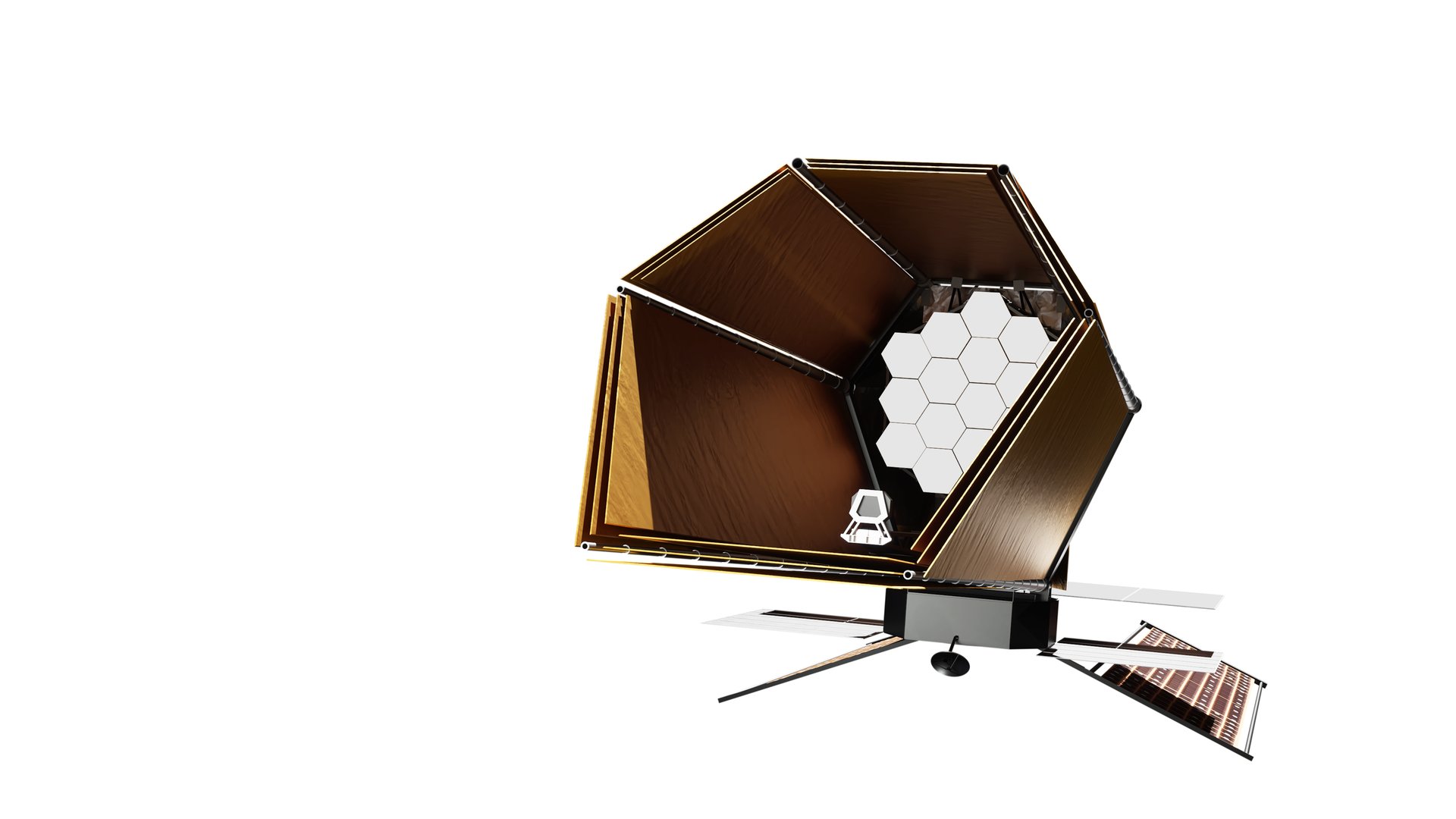 Engineering Architecture Concept 1 (EAC-1) for NASA’s Habitable Worlds Observatory. This is an early design study, not the final telescope configuration. Image: NASA’s Goddard Space Flight Center / Conceptual Image Lab (public domain)
NASA’s next flagship space telescope after the Nancy Grace Roman Space Telescope will be designed not just to observe the universe but to be repaired, upgraded, and maintained by robots in deep space. The Habitable Worlds Observatory (HWO), estimated at $11 billion and targeting a launch in the late 2040s, will directly image at least 25 Earth-like exoplanets and search their atmospheres for chemical biosignatures — oxygen, ozone, and methane. But the mission’s most consequential innovation may not be its optics. It is the decision to engineer the telescope from the ground up as a modular, robotically serviceable platform stationed at the Sun-Earth Lagrange Point 2, 1.5 million kilometers from Earth.
In Brief
- HWO is NASA’s next flagship astrophysics mission after Roman, recommended by the National Academies’ Decadal Survey (Pathways to Discovery, 2021).
- The telescope will carry a 6-to-8-meter primary mirror and an internal coronagraph capable of suppressing starlight by a factor of 10 billion to directly image exoplanets.
- Its primary science goal is to identify and spectroscopically analyze at least 25 potentially habitable worlds orbiting sun-like stars within 30 light-years.
- Unlike JWST, HWO is being structurally engineered for robotic in-space servicing, assembly, and maintenance (ISAM) from the start of its design.
- Critical systems will be configured as line-replaceable units with mechanical docking interfaces and self-aligning connectors for robotic manipulation.
- The estimated cost is $11 billion, with a launch target in the late 2040s, though NASA is working to accelerate that timeline.
What Is the Habitable Worlds Observatory?
According to NASA’s mission page, HWO is a large infrared, optical, and ultraviolet space telescope — the first designed specifically to search for signs of life on planets orbiting other stars. It builds on two earlier mission concept studies: the Large Ultraviolet Optical Infrared Surveyor (LUVOIR) and the Habitable Exoplanets Observatory (HabEx), both considered by the National Academies’ 2020 Decadal Survey on Astronomy and Astrophysics.
The survey, titled Pathways to Discovery in Astronomy and Astrophysics for the 2020s, recommended a six-meter-class infrared/optical/ultraviolet telescope as the top priority for the decade. NASA formally designated the mission as HWO and began preliminary engineering work.
HWO’s primary objective is ambitious: directly image and spectroscopically characterize at least 25 potentially habitable exoplanets — planets roughly the size of Earth orbiting in the habitable zones of sun-like stars — within 30 light-years of our solar system. The telescope will search these planets’ atmospheres for chemical biosignatures, including oxygen, ozone, and methane, which could serve as evidence of biological activity.
Beyond exoplanet science, HWO will serve as a general-purpose observatory studying the formation of galaxies, the evolution of cosmic structures, and the nature of dark matter and dark energy — capabilities described by NASA as providing “transformational astrophysics” discoveries.
The Starlight Problem: Why Direct Imaging Is So Hard
Directly imaging an Earth-like exoplanet is one of the most technically demanding tasks in astronomy. A planet like Earth orbiting a star like our Sun is roughly 10 billion times fainter than its host star in visible light. From a telescope’s perspective, the planet is not just a tiny dot next to a bright object — it is a photon signal buried under an overwhelming glare.
To solve this, HWO will use an internal coronagraph, an optical device that blocks the light from a star while allowing the much fainter light from orbiting planets to pass through. According to NASA, the coronagraph must suppress starlight by a factor of 10 billion. This requires the telescope’s optical system to maintain extraordinary stability: the mirror segments and instrumentation cannot fluctuate by more than a fraction of a picometer — roughly 1/50th the diameter of a hydrogen atom — during multi-hour observation windows.
Achieving this stability demands thousands of active control sensors and micro-actuators operating continuously to counteract microscopic structural warping caused by solar radiation gradients and mechanical vibrations from reaction wheels. This is not merely a matter of building a bigger mirror; it is a systems engineering challenge that touches every component of the spacecraft.
A 6-to-8-Meter Mirror — Too Big for a Single Rocket?
HWO’s primary mirror is expected to be between 6 and 8 meters in diameter. For comparison, JWST’s primary mirror is 6.5 meters, and it had to be folded like origami to fit inside an Ariane 5 fairing. HWO faces a similar constraint: even with next-generation super heavy-lift rockets, a monolithic 8-meter mirror may not fit inside a payload fairing.
This is where the mission’s in-space assembly architecture becomes not just a maintenance feature but a construction necessity. According to reporting by SatNews, if the finalized mirror configuration exceeds the volumetric fairing constraints of available rockets, NASA may use robotic servicers to assemble and align the segmented mirror directly in orbit. The mirror would launch in segments, and a robotic spacecraft would connect and calibrate the pieces at the operational location.
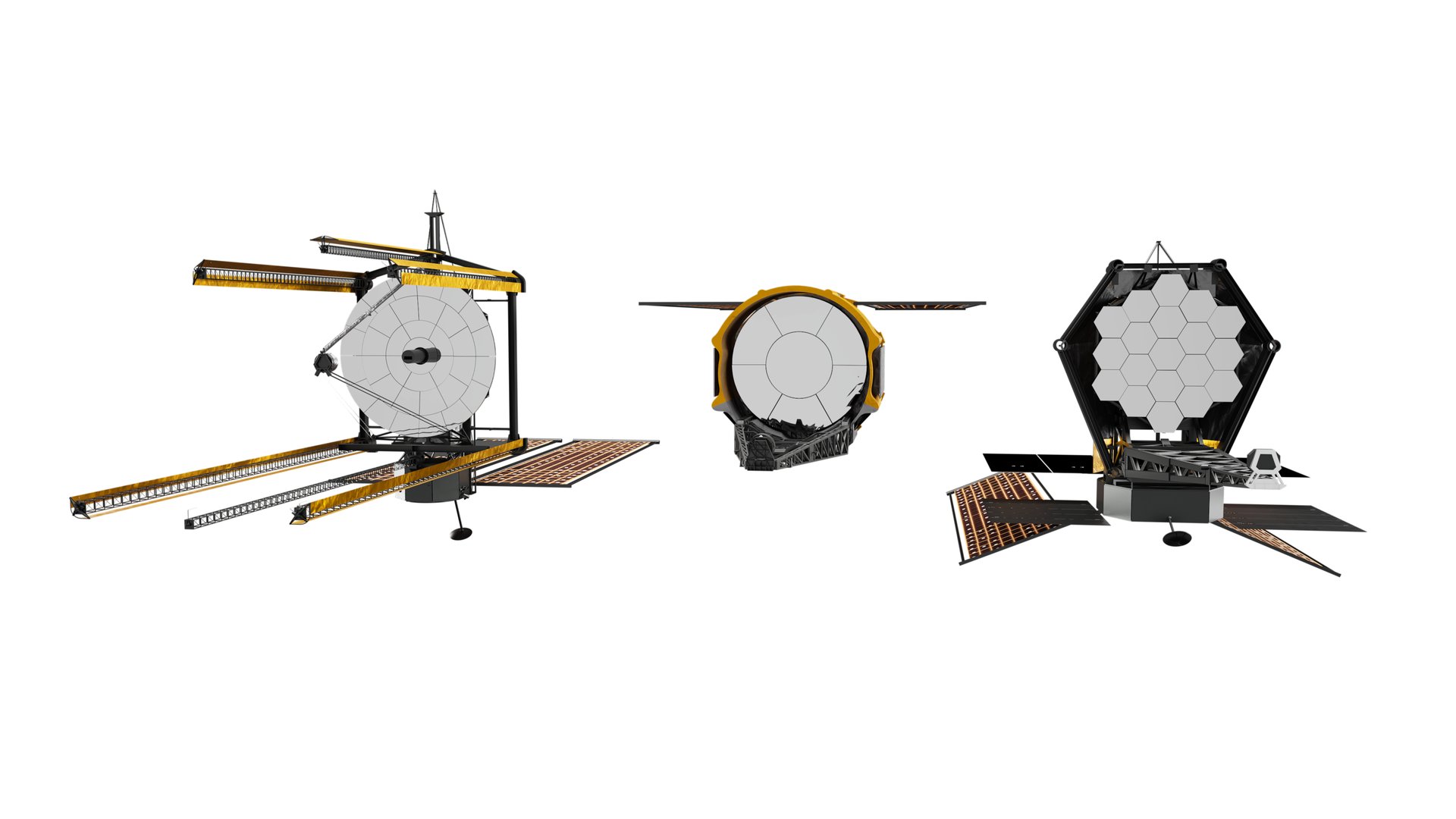 Engineering concept of the Habitable Worlds Observatory’s segmented mirror configuration. NASA engineers are studying multiple mirror architectures as part of the design trade space. Image: NASA’s Goddard Space Flight Center / Conceptual Image Lab (public domain)
The Radical Departure: Built for Servicing, Not Abandonment
What makes HWO fundamentally different from every previous flagship space telescope is its design philosophy. Hubble was repaired by Space Shuttle astronauts five times because it orbited in low Earth orbit, reachable by crewed spacecraft. JWST, by contrast, orbits at L2, far beyond any crewed mission capability. If something breaks on JWST, it stays broken.
HWO will also operate at L2, making human servicing impossible. But instead of accepting a fixed-lifecycle design, NASA is mandating a modular, robotically accessible architecture from the project’s inception. Speaking at the American Astronomical Society’s 248th meeting in Pasadena, NASA astrophysics division director Shawn Domagal-Goldman confirmed that HWO is being structurally engineered to require robotic in-space servicing, assembly, and maintenance.
The design blueprint calls for all critical electronic systems, command-and-control computers, and optical sensor arrays to be configured as standardized line-replaceable units (LRUs). These modules will be fitted with mechanical docking interfaces, self-aligning electrical connectors, and blind-mate guide pins optimized for robotic manipulation. A robotic servicing spacecraft could latch onto the observatory, release mechanical locking collars, slide out degraded or obsolete instruments, and insert next-generation sensors.
This approach mirrors the philosophy behind Northrop Grumman’s MRV-1, which launched in July 2026 to demonstrate robotic satellite servicing in geosynchronous orbit. But HWO applies the concept to a vastly more complex and sensitive scientific instrument — one where the tolerance for error is measured in picometers, not millimeters.
Why This Matters
The shift from disposable to serviceable space telescopes has implications that go beyond engineering:
Cost efficiency. Flagship space telescopes cost billions and take decades to build. If HWO can be upgraded rather than replaced, each generation of scientific instruments can be swapped in without launching an entirely new observatory. This could dramatically reduce the long-term cost of flagship astronomy.
Technological currency. A telescope designed in the 2030s and launched in the 2040s will carry instruments based on 2020s-era technology. Without servicing, those instruments become increasingly outdated over a 10-to-20-year mission. With modular upgrades, HWO can incorporate sensors and processors developed in the 2050s or 2060s — technology that does not exist yet.
Commercial ecosystem. NASA’s servicing mandate creates a guaranteed customer for the emerging in-space servicing, assembly, and manufacturing (ISAM) industry. The Roman Space Telescope, which launched in August 2026, demonstrated NASA’s commitment to large-format infrared astronomy. HWO extends that commitment into the domain of serviceable infrastructure.
Risk reduction. JWST survived its launch and deployment with no failures, but the mission carried enormous risk because nothing could be fixed if something went wrong. A serviceable architecture distributes risk across time — a stuck mechanism or degraded sensor becomes a service call, not a mission-ending failure.
What This Means for Product Builders and Engineers
From a product-building perspective, HWO represents one of the most ambitious examples of designing for maintainability in an environment where maintenance was previously impossible. The principle — architect for serviceability from day one rather than bolting it on later — is relevant to any team building complex systems.
For hardware teams, the concept of line-replaceable units with standardized interfaces is not new. Aerospace has used LRUs for decades. What is new is applying this principle to a cryogenic space telescope operating at picometer stability, where every connector and interface must work flawlessly after years of thermal cycling in deep space. The engineering challenge of designing a module that a robotic arm can remove and replace — while maintaining optical alignment to within a fraction of a hydrogen atom’s diameter — is extraordinary.
For Pakistani technology teams and educators, this mission is a case study in systems engineering at the frontier. The modular architecture, the trade-off between monolithic and assembled mirrors, the decision to build servicing requirements into the baseline design rather than treating them as a nice-to-have — these are the kinds of engineering decisions that students and early-career engineers can learn from. LearnOSTEAM, with its focus on hands-on STEAM education, and RoboSim, which teaches programming through simulated robotics, are both platforms where concepts like modular design, robotic manipulation, and systems thinking can be introduced to the next generation of engineers.
What to Watch Next
- Engineering Architecture Concepts (EACs): NASA has released multiple EACs representing different design trade-offs. EAC-1 is shown above, but the final design will likely differ. Watch for EAC-2 and EAC-3 as the design matures.
- Technology maturation programs: NASA is funding precursor technology development for HWO’s coronagraph, mirror segments, and robotic servicing interfaces. Progress in these programs will indicate whether the late-2040s launch target is realistic.
- ISAM industry development: The success of HWO’s servicing architecture depends on the maturation of the commercial in-space servicing sector. The MRV-1 mission at GEO and DARPA’s RSGS program are the near-term demonstrations that will validate the robotic capabilities HWO will eventually rely on.
- Decadal survey progress: NASA is working to accelerate HWO’s development timeline. Watch for schedule updates at AAS meetings and in NASA budget requests.
Conclusion
The Habitable Worlds Observatory is a bet that the future of space astronomy looks less like a single-use probe and more like a piece of infrastructure — built to last, designed to evolve, and maintained by robots in the cold emptiness of deep space. If the mission succeeds, it will not only answer whether life exists on other Earth-like worlds. It will also prove that the most complex machines humans have ever built can be designed for a lifecycle that spans generations rather than decades.
For anyone building technology products, the lesson is straightforward: the decisions you make about serviceability, modularity, and upgrade paths at the beginning of a project will determine how long your creation remains useful. NASA is making that bet with an $11 billion telescope. You can make it with whatever you are building next.
Sources
- NASA Science — Habitable Worlds Observatory mission page
- SatNews — NASA Mandates In-Space Servicing Architecture for $11 Billion Habitable Worlds Observatory
- SpaceNews — NASA seeks to accelerate development of Habitable Worlds Observatory
- National Academies of Sciences, Engineering, and Medicine. 2021. Pathways to Discovery in Astronomy and Astrophysics for the 2020s. Washington, DC: The National Academies Press.