NASA's Lunar Reactor-1 RFP: What the First Moon Nuclear Power Plant Means for Space Engineering
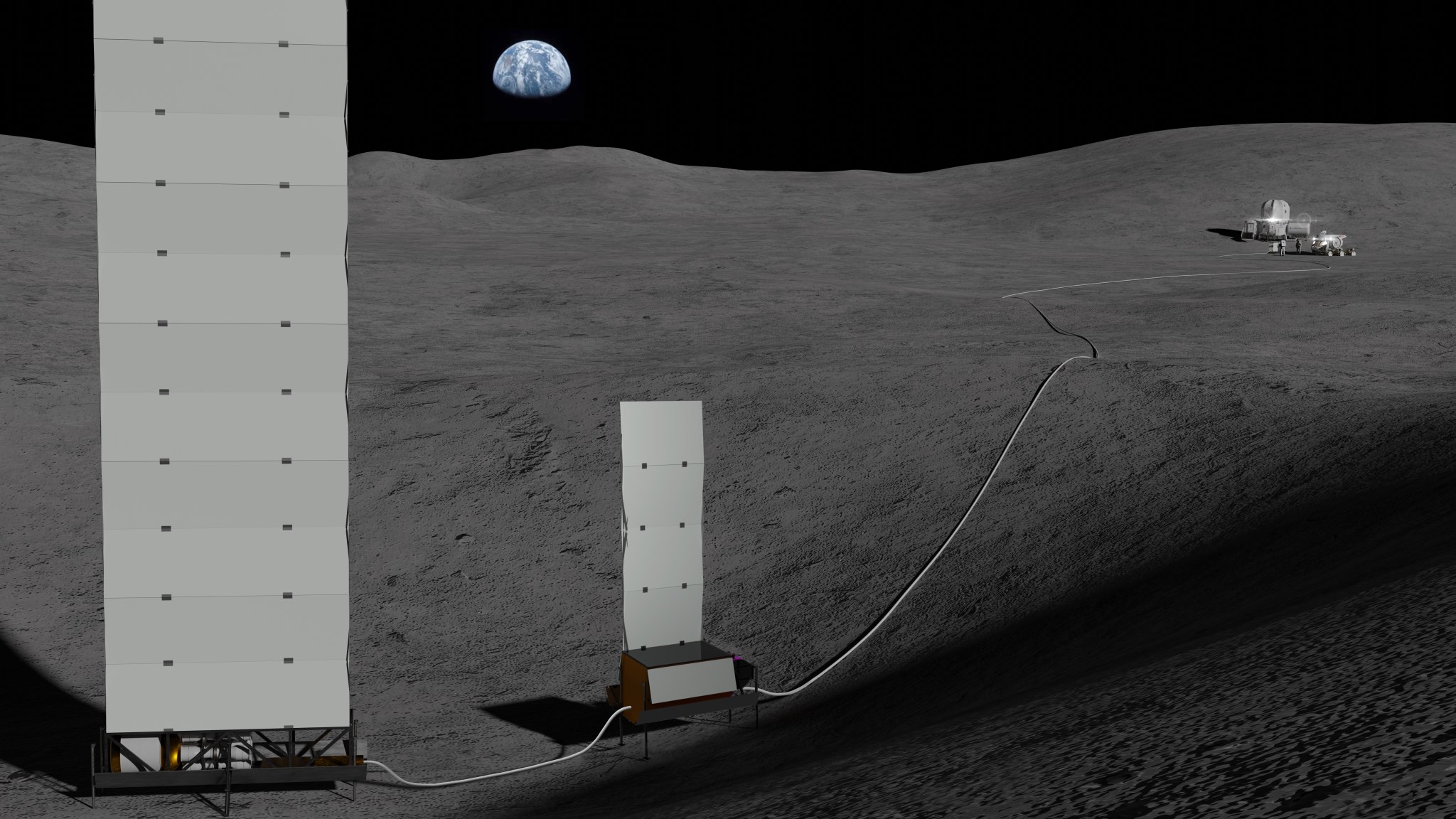 Artist’s concept of a fission power system on the lunar surface. A vertical radiator and a smaller unit in the foreground connect via cables to a habitat and rover in the distance. Earth is visible above the lunar horizon. Image: NASA (public domain)
On November 23, 2026, NASA issued a formal Request for Proposals (RFP) for Lunar Reactor-1 (LR-1) — the first nuclear fission reactor designed to generate electricity on the Moon. The solicitation asks industry partners to develop, test, and deliver a 20-kilowatt reactor that can operate continuously on the lunar surface for at least five years, with a target launch-ready date of 2030. Proposals are due December 21.
In Brief
- NASA’s Space Power and Reactor Capabilities RFP seeks industry partners to build Lunar Reactor-1 (LR-1), a 20-kilowatt fission power system for the Moon.
- The reactor must generate enough electricity to power approximately 16 average U.S. households annually — sufficient for habitats, communications, rovers, and scientific instruments on NASA’s planned Moon Base.
- Proposals are due by December 21, 2026. The reactor must meet Department of Energy safety standards for nuclear operations.
- Unlike solar power, LR-1 will operate continuously through the Moon’s roughly 14-day nights, when solar panels are useless.
- The RFP also covers potential future task orders for other space nuclear power systems, including SR-1 Freedom, a nuclear-electric propulsion mission launching in 2028.
- NASA and DOE hosted an industry day in September at the Ohio Aerospace Institute in Cleveland and incorporated feedback from a draft proposal released in August.
What Lunar Reactor-1 Actually Does
LR-1 is a small fission surface power system. It splits uranium atoms in a controlled chain reaction, and the heat from that reaction drives a power conversion system that generates electricity. The reactor produces 20 kilowatts — enough to power roughly 16 average U.S. households on Earth, according to NASA. On the Moon, that energy supports the infrastructure needed for a sustained human presence: habitats, life support, communications, rovers, scientific instruments, and in-situ resource utilization equipment.
The 20-kilowatt figure is not arbitrary. It represents the minimum power needed to keep a small lunar outpost operational through the lunar night. During lunar day — roughly 14 Earth days of continuous sunlight — solar panels can supplement or replace reactor power. But during lunar night, when temperatures at the equator drop to around -130°C and there is no sunlight whatsoever, fission is the only technology that can deliver kilowatt-scale power without interruption. Batteries capable of storing two weeks of outpost energy would be prohibitively heavy to launch.
NASA’s RFP requires the reactor to operate for at least five years after deployment. That is a meaningful commitment for a machine that cannot be serviced in the conventional sense. Lunar surface maintenance is not like terrestrial maintenance — there is no repair technician, and even under NASA’s Moon Base plans, crewed visits will be intermittent. The reactor must be designed for autonomous, fault-tolerant operation over its full design life.
Why Nuclear Instead of Solar
The case for nuclear power on the Moon comes down to one number: 14. The lunar night lasts approximately 14 Earth days. During that period, a solar-powered outpost must either shut down or run on stored energy.
Shutting down is not an option for a habitat. Life support systems, communications, and thermal management must run continuously. Storing two weeks of power in batteries is technically possible but mass-inefficient. The energy density of current battery technology — even lithium-ion — means that a battery pack large enough to sustain a 20-kilowatt load for 14 days would weigh tens of tons, requiring multiple dedicated launches just for energy storage.
Nuclear fission solves this problem entirely. A reactor runs day and night, independent of sunlight, weather, or season. It is compact relative to its power output. And it can be scaled: NASA’s earlier Kilopower Reactor Using Stirling Technology (KRUSTY) experiment, tested at the Nevada National Security Site in 2018, demonstrated a 1-kilowatt reactor. LR-1 scales that concept to 20 kilowatts — a factor of 20 — using engineering knowledge gained from both KRUSTY and the SR-1 Freedom space reactor program.
This is not the first time nuclear power has been considered for space. Radioisotope thermoelectric generators (RTGs) have powered NASA missions from Voyager to Curiosity for decades. But RTGs produce hundreds of watts, not kilowatts. LR-1 produces two orders of magnitude more power — enough to run a base, not just an instrument.
How LR-1 Connects to SR-1 Freedom and the Moon Base
LR-1 does not exist in isolation. It is part of a two-reactor architecture that NASA and the Department of Energy formalized in October 2026 through a Memorandum of Understanding establishing the “Nuclear NASA-era”.
The first reactor, SR-1 Freedom, is a 20-kilowatt-electric space reactor scheduled to launch in 2028. SR-1 Freedom will demonstrate nuclear-electric propulsion — using a reactor to power ion thrusters for deep-space travel. It will travel to Mars and deploy SkyFall helicopters based on the Ingenuity design. SR-1 Freedom proves that a space reactor can operate in the vacuum and radiation environment of deep space.
LR-1 is the surface counterpart. It takes the same reactor technology and adapts it for lunar surface operations. The key differences are in the heat rejection system (surface radiators operate in vacuum but with a lunar regolith interface, not open space), the power conversion hardware, and the structural requirements for surviving launch and landing on the Moon.
Together, the two missions address both sides of the space nuclear power problem: propulsion for getting there, and power for staying there. NASA’s broader Moon Base program — which includes the $10 billion CLPS 2 cargo delivery contracts announced in November — depends on having reliable surface power. Without LR-1 or an equivalent system, the Moon Base cannot sustain operations through the lunar night.
What the RFP Tells Us About NASA’s Strategy
The RFP reveals several strategic choices that are worth examining.
Open competition, not sole-source. NASA is not awarding LR-1 to a pre-selected contractor. The RFP is open to industry, and the agency has incorporated feedback from a draft released in August and an industry day in September. This suggests NASA wants to survey what the private sector can offer — potentially at lower cost or with faster timelines than a government-directed program.
DOE safety standards as a hard requirement. The solicitation explicitly states that the reactor must meet Department of Energy safety standards for nuclear operations. This is not a NASA-only technical standard — it is a nuclear regulatory requirement. It means the winning proposal must demonstrate that the reactor can be launched, transported, deployed, and operated without violating DOE nuclear safety protocols. This is a significant engineering and regulatory hurdle, and it ensures that safety is not traded against schedule.
Flexibility for future systems. The RFP is structured to allow NASA to issue additional task orders for other space nuclear power systems beyond LR-1. This means the contract vehicle could eventually cover follow-on reactors — higher-power systems for a larger Moon Base, reactors for Mars surface operations, or additional propulsion systems. NASA is building a procurement framework, not just buying one reactor.
The 2030 deadline. President Trump’s December 2025 Executive Order on Ensuring American Space Superiority directed NASA to develop a launch-ready lunar surface reactor by 2030. That gives the winning contractor roughly four years to finalize a design, build, test, and qualify a space-qualified fission reactor. For context, the KRUSTY experiment took roughly three years from concept to ground test — but that was a 1-kilowatt prototype, not a 20-kilowatt flight unit. The timeline is aggressive but not impossible, provided the design leverages existing reactor technology rather than starting from scratch.
The Engineering Challenges That Get Less Attention
Most coverage of lunar nuclear power focuses on the reactor itself. But several engineering challenges receive less attention and will determine whether LR-1 succeeds.
Heat rejection in vacuum. A fission reactor generates enormous heat, only a fraction of which becomes electricity. The rest must be radiated away. On Earth, reactors use water or air cooling. On the Moon, there is no atmosphere — heat can only be removed through thermal radiation, which is far less efficient. LR-1’s radiator system will likely be the largest single component by mass and surface area. The NASA concept image shows a large vertical radiator dominating the foreground — that is not artistic license. It reflects the physics.
Lunar dust. The Moon’s surface is covered in regolith — sharp, abrasive particles that cling to everything electrostatically. Regolith on radiator surfaces degrades their thermal performance. Any mechanical deployment system — doors, actuators, cable connectors — must be designed to tolerate dust contamination. NASA has been studying lunar dust mitigation since Apollo, but a multi-year reactor operation imposes far more stringent requirements than a few days of surface activity.
Autonomous control. LR-1 must start up, shut down, and respond to faults without human intervention. Communication latency between Earth and the Moon is about 1.3 seconds each way — manageable for some operations, but too slow for a reactor that might need to scram (emergency shutdown) in milliseconds. The control system must be fully autonomous, with fail-safe logic that can handle any anticipated fault without ground supervision.
Launch safety. A fission reactor contains uranium fuel. Launching nuclear material requires extensive safety analysis, environmental impact statements, and public review. The reactor must be designed to survive a launch accident — including explosion, fire, and impact — without dispersing radioactive material. NASA and DOE have established protocols for launching radioisotope sources, but a fission reactor presents a larger and more complex safety case.
Why This Matters for Pakistan, Educators, and Technology Builders
For STEAM educators, LR-1 is an exceptional teaching case because it requires integrating physics, thermodynamics, materials science, control systems, and regulatory engineering — all under constraints that are easy to explain but extraordinarily difficult to satisfy. A reactor that must run for five years without maintenance, in vacuum, at -130°C, surrounded by abrasive dust, is a problem that makes every engineering trade-off visible.
For Pakistani technology teams, the LR-1 program illustrates a principle that is relevant even without direct participation: complex systems require structural partnerships, not just competent engineering. NASA is not building this reactor alone. It is partnering with DOE for nuclear expertise, with private industry for design and manufacturing, and with the CLPS 2 contractors for delivery to the lunar surface. The lesson for Pakistani founders and product builders is that scaling ambitious hardware requires building a coalition of partners with complementary capabilities — a pattern familiar to anyone who has worked on educational robotics platforms or scalable STEAM learning systems.
For the broader space community, LR-1 represents a litmus test for whether nuclear power can move from prototype to operational infrastructure. If LR-1 succeeds, the path opens for larger reactors — 100 kilowatts, then a megawatt — that could power Mars surface missions, asteroid mining operations, and deep-space habitats. If it fails or slips significantly, the Moon Base program loses its power foundation.
What to Watch Next
- December 21 proposal deadline. Watch for which companies submit proposals. The quality and credibility of the bidding field will signal whether the 2030 timeline is realistic.
- SR-1 Freedom milestones. SR-1 Freedom’s 2028 launch is the technical precursor to LR-1. Major hardware delivery milestones in 2027 will indicate whether the reactor technology is on track.
- DOE safety review timeline. The safety case for launching a fission reactor will require months of review. When NASA submits the safety documentation — likely in 2028 or 2029 — the thoroughness of that process will determine whether the 2030 launch-ready date holds.
- International responses. China has announced plans for a nuclear-powered lunar base. Russia has explored space nuclear propulsion. The LR-1 RFP may accelerate parallel programs in other countries.
Conclusion
NASA’s Lunar Reactor-1 RFP is a concrete step beyond policy announcements. It asks industry to build a machine that will run for five years on the Moon, unattended, in conditions that would destroy most terrestrial equipment. The December 21 proposal deadline will reveal which companies believe they can meet that challenge. Whether LR-1 launches by 2030 or slips — as ambitious space programs often do — the RFP itself signals that nuclear power has moved from the periphery of lunar exploration planning to its core.
The question worth asking is not whether a 20-kilowatt reactor is technically feasible. KRUSTY proved the concept at 1 kilowatt. The question is whether the industrial base, regulatory framework, and supply chain can scale from prototype to qualified flight hardware in four years. That is a management and systems engineering problem as much as a technical one — and it is exactly the kind of problem that determines whether ambitious space programs succeed.
Sources
- NASA Seeks Partners to Design First Nuclear Reactor for the Moon — November 23, 2026, NASA Technology news release
- NASA, Energy Department Advance New Era of Nuclear-Powered Exploration — October 8, 2026, NASA Headquarters news release
- NASA’s $10 Billion Moon Base Build-Out: CLPS 2 and PROMISE Nuclear Rover — November 8, 2026, ShamylMansoor.com
- NASA-DOE Nuclear Space Agreement: SR-1, LR-1 and Dragonfly — October 11, 2026, ShamylMansoor.com
- How NASA’s SR-1 Freedom Nuclear Propulsion Mission Works — August 16, 2026, ShamylMansoor.com