Nvidia PAIR: How Distributed Local AI Inference Could Reshape Affordable Compute for Developers and Education
Nvidia released the Personal AI Router (PAIR) on September 3, 2026, at IFA 2026 — a free, open-source tool that discovers compatible computers on a home network and distributes local AI inference requests across whichever machine has available GPU capacity. For developers, makers, and educators who have been priced out of cloud-based AI APIs or lack access to data-center hardware, PAIR offers a practical path to running multi-agent workflows on hardware that is already sitting in the room.
The tool is available now in beta for Windows, Linux, and macOS, works with Ollama and LM Studio, and carries an Apache-2.0 license. It is not a hardware product. It is software that turns the gaming PC, the work laptop, and the spare desktop in a household or small office into a coordinated inference cluster.
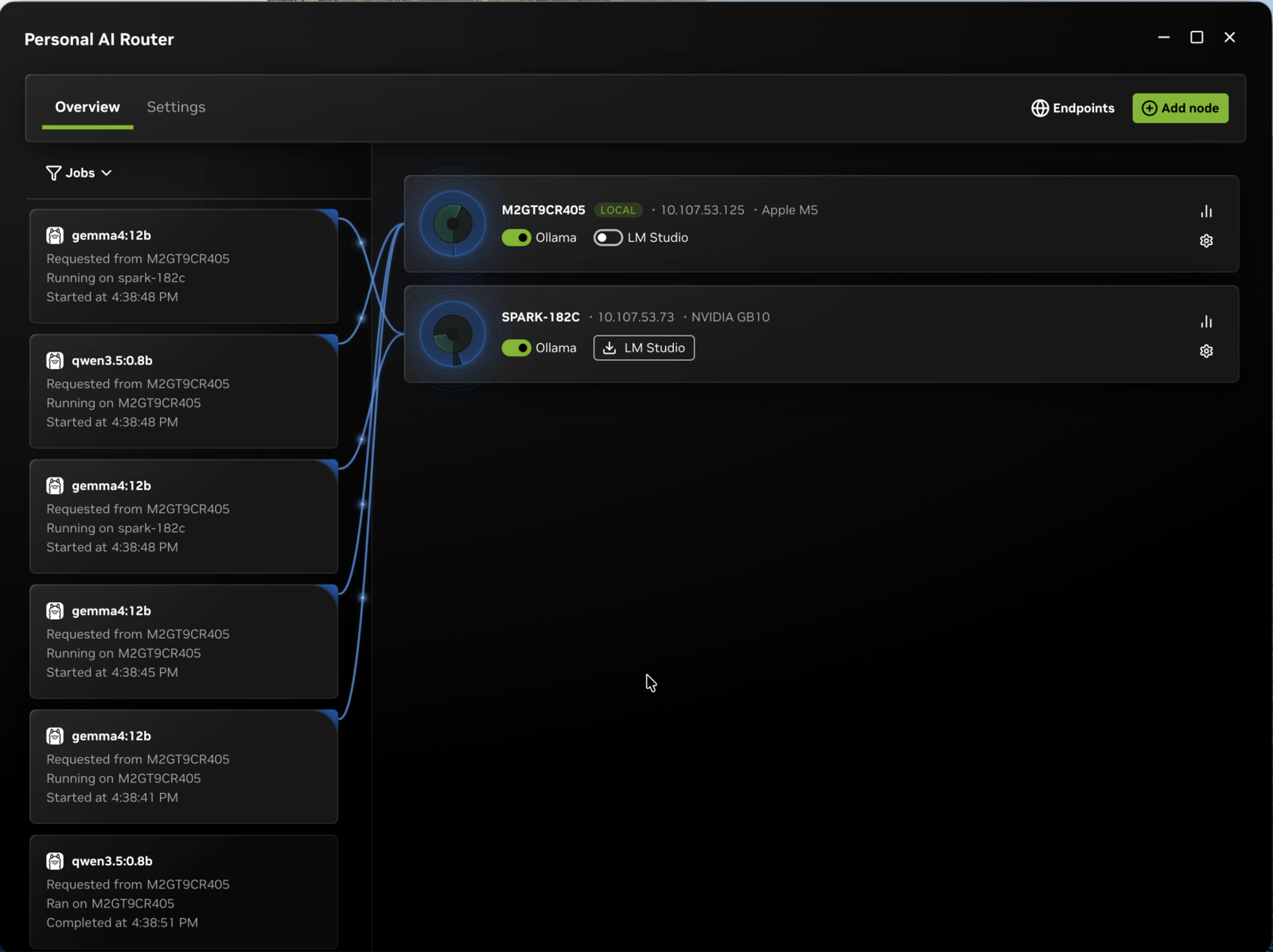
Screenshot from the Nvidia Personal AI Router GitHub repository (Apache-2.0 license), showing the PAIR desktop application with two paired nodes and live inference traffic distribution.
In Brief
- Nvidia PAIR is a free, open-source local inference router that distributes AI requests across multiple PCs on the same network
- It works with Ollama and LM Studio, supports Nvidia GeForce RTX 20-series and newer GPUs, RTX PRO workstation GPUs, DGX Spark systems, and Apple M4 or newer silicon
- The tool routes independent inference requests to available nodes — it does not shard models across machines or pool GPU memory
- Pairing is secured through a six-digit code followed by mTLS encryption; devices can join and leave the network dynamically
- Beta installers are available for Windows (.exe), Linux (.deb), and macOS (.dmg) from the GitHub repository
- Announced alongside PAIR: simplified local AI setup for Hermes Agent, OpenClaw, and Perplexity Portable Computer on Nvidia RTX GPUs
What Problem PAIR Solves
Running local AI models on a single machine creates a bottleneck. A developer running a multi-agent workflow — say, one agent reviewing code while another searches documentation and a third writes tests — is sending multiple concurrent inference requests to the same GPU. When the GPU is busy with one request, the others wait. Performance degrades as more agents compete for the same resources.
This is the problem that Nvidia product manager Seth Schneider described at a media briefing ahead of IFA. According to Nvidia, more than half of U.S. households have two or more PCs, and most of that computing power sits idle throughout the day. Schneider painted a scenario where a household with an RTX Spark laptop, a DGX Spark desktop, an RTX 5090 laptop, a gaming desktop, and a MacBook Pro has roughly 165 teraflops of underutilized compute — what he called “a treasure trove of free tokens just sitting in homes today.”
PAIR addresses the single-GPU bottleneck by routing independent inference requests to whichever paired node has capacity. If a developer’s main workstation is busy running a large model, PAIR can send the next request to a paired laptop or spare desktop that has an available GPU. The result is more parallelism for agentic workloads without investing in additional hardware.
How PAIR Actually Works
According to the official documentation on GitHub, PAIR is a local inference router — not a distributed training framework or a model-sharding system. The distinction matters:
What PAIR does: Discovers participating computers on the local network, manages supported inference engines (Ollama and LM Studio), and presents Ollama-compatible and OpenAI-compatible proxy endpoints to applications and agents. When an inference request arrives, PAIR routes it to an eligible node based on engine availability, model availability, and current workload.
What PAIR does not do: Pool GPU memory across machines, combine multiple GPUs into a larger logical GPU, shard a single model across networked machines, or split an in-flight inference request between nodes. Each request runs entirely on one node. This means you cannot run a model that requires 24 GB of VRAM across two 12 GB GPUs on separate machines — but you can run two different 12 GB models simultaneously on two separate machines.
The architecture is straightforward: one machine runs the PAIR desktop application, which manages the network. Other machines pair with it using a six-digit code, and the connection is then secured with Mutual Transport Layer Security (mTLS). Once paired, each node reports its available engines, loaded models, and current GPU utilization. PAIR uses this information to route requests intelligently.
Devices can join and leave the network at any time. If someone starts playing a game on their desktop, PAIR automatically redirects inference workloads to other available nodes. This adaptability is important for real-world use, where computers are shared between work and personal tasks.
Compatibility and Requirements
PAIR supports a specific but broad range of hardware:
- Nvidia GPUs: GeForce RTX 20-series and newer, RTX PRO workstation GPUs (Turing architecture and newer), and DGX Spark systems
- Apple Silicon: M4 or newer
- Operating systems: Windows 11, Linux (x64 and arm64), macOS (x64 and arm64). Windows on ARM is listed as experimental.
- Inference engines: Ollama and LM Studio
PAIR itself runs on any supported operating system regardless of GPU — but an inference engine (Ollama or LM Studio) must be running on a node for it to receive inference requests. Whether a specific model runs on a specific machine depends on the engine’s requirements and available memory, not on PAIR itself.
The tool offers both a graphical desktop interface and a terminal interface for machines without a desktop environment. Installers are available from the GitHub releases page, and the full source code is available under the Apache-2.0 license.
What This Means for Developers and Product Teams
For product teams and developers, PAIR changes the economics of local AI in several ways.
First, it makes multi-agent workflows practical on consumer hardware. A team of three developers with individual workstations — each with a mid-range RTX GPU — can pool their idle compute for local inference during the workday. This is particularly relevant given the growing interest in agentic AI, where a single task might involve multiple agents running in parallel. Nvidia’s own announcement highlighted this use case: a Hermes agent creating a “Sunday Reset” plan by sorting through an inbox can split subtasks across multiple machines, with PAIR distributing the jobs across available PCs.
Second, it reduces dependence on cloud AI APIs. For teams in markets where cloud AI costs are prohibitive — and exchange rates make dollar-denominated API pricing even more expensive — local inference on existing hardware is not just a privacy choice. It is an economic necessity. A developer in Pakistan paying for OpenAI or Anthropic API calls in USD feels the cost difference acutely. PAIR makes it feasible to run more of that workload locally, on hardware that may already be in the office.
Third, it complements the broader ecosystem of local AI tools. Alongside PAIR, Nvidia announced up to 1.9x faster local inference through llama.cpp optimizations on RTX 5090 GPUs, and simplified local model setup in three agent applications: Hermes Agent (developed by Nous Research), OpenClaw, and Perplexity Portable Computer. Each of these tools now offers one-click setup on RTX GPUs, reducing the friction that has kept many developers on cloud APIs even when local hardware is available.
Why This Matters for Education
For educators and educational institutions, PAIR has a specific and practical appeal.
Schools and universities in emerging markets often have computer labs with multiple PCs but limited budgets for cloud AI services. A lab with ten mid-range gaming PCs — each with an RTX 3060 or similar — could use PAIR to create a local inference cluster for AI coursework. Students could run real models, experiment with agentic workflows, and learn AI engineering without the institution paying for API credits or worrying about data leaving the network.
This connects directly to the challenge of building scalable educational robotics platforms where infrastructure costs are a persistent barrier. The same principle — using existing hardware more efficiently rather than buying new hardware — applies to both robotics simulation and AI education.
For STEAM programs that already use educational robot kits or 3D simulation environments, PAIR could power local AI assistants that help students with coding, debugging, and project planning — all without sending student data to a cloud API.
Relevance to Pakistan and Emerging Markets
In Pakistan, the cost barrier to AI adoption is not theoretical. Cloud AI APIs are priced in U.S. dollars, and the rupee’s exchange rate makes per-token costs significantly higher in local terms than they are for a developer in the United States or Europe. A startup or university lab that wants to experiment with agentic AI workflows faces a choice: pay international API rates, or find a way to run models locally.
PAIR makes the local option more viable. A technology company in Islamabad with a few developer workstations — each with a consumer GPU — can set up a local inference cluster in an afternoon. No data leaves the office. No recurring API costs accrue. The main investment is the hardware that the team likely already owns.
This is also relevant in the context of Pakistan’s growing technology export sector and the broader push for digital infrastructure development. Local AI capability reduces dependence on foreign cloud providers, which is both an economic and a strategic consideration for technology teams building products for domestic and international markets.
Product Builder’s Perspective
From a product-building perspective, PAIR is interesting not just as a tool but as a design pattern. The core insight — that distributed inference across existing hardware is more practical than model sharding across networked machines — reflects a pragmatic engineering choice. Routing independent requests to separate nodes is simpler, more robust, and more useful in practice than trying to make multiple GPUs behave as one.
The decision to support both Ollama and LM Studio, and to expose Ollama-compatible and OpenAI-compatible proxy endpoints, means that existing applications and agent frameworks can use PAIR without modification. Any tool that already talks to Ollama or the OpenAI API can point at PAIR’s proxy endpoint and get distributed inference for free. This is a smart interoperability choice that lowers adoption friction.
The Apache-2.0 license is also significant. It means the tool can be studied, modified, and embedded in other projects. For a product team building a local AI platform — for education, for enterprise, or for a specific vertical — PAIR’s routing layer could be integrated or adapted without licensing constraints.
One limitation worth noting: PAIR requires a local network. It is designed for home or office use, not for geographically distributed teams. A team with machines in different cities cannot use PAIR without a VPN or similar network bridge. This limits the tool’s applicability for remote-first organizations, though a VPN overlay is a workable workaround.
What to Watch Next
Several developments will determine whether PAIR becomes a meaningful tool for the broader AI ecosystem:
- Engine support expansion. PAIR currently supports Ollama and LM Studio, both of which use llama.cpp under the hood. Support for vLLM — which is more common on DGX Spark and enterprise hardware — would significantly expand the tool’s utility. A community project already exists to add vLLM as a third-party engine, suggesting demand is real.
- Model compatibility. PAIR routes requests to nodes that already have the requested model loaded. If two machines have different models loaded, PAIR cannot split a single conversation across them. This means teams need to coordinate which models run on which machines — a management overhead that may need tooling.
- Adoption beyond Nvidia’s ecosystem. PAIR supports Apple Silicon, which is a meaningful signal that Nvidia is not locking the tool to its own hardware entirely. Whether AMD or Intel GPU support follows will determine how broadly the tool can serve the developer community.
- Integration with agent frameworks. Nvidia announced simplified setup for Hermes Agent, OpenClaw, and Perplexity Portable Computer. Whether other agent frameworks — AutoGen, CrewAI, LangGraph — add PAIR support will influence how quickly it becomes a standard part of the local AI stack.
Conclusion
Nvidia PAIR is a pragmatic tool that solves a real problem: the gap between what a single consumer GPU can handle and what multi-agent AI workflows require. By distributing inference across existing hardware on a local network, it makes local AI more practical for developers, educators, and teams that cannot or do not want to rely entirely on cloud APIs. The Apache-2.0 license and cross-platform support make it accessible enough that a small team or school lab can set it up in an afternoon.
For developers and product teams in emerging markets, where cloud AI costs are a genuine barrier, tools like PAIR matter more than they might in Silicon Valley. They represent a path to AI capability that runs on hardware already in the building, without recurring costs denominated in a foreign currency.
If you have two or more PCs with supported GPUs on the same network, PAIR is worth trying. The beta is available now from the GitHub repository.
Sources
- Nvidia Blog: Sparks Fly: NVIDIA Accelerates Local AI at IFA 2026 — September 3, 2026
- The Verge: Nvidia launches free tool that links idle computers into a personal AI data center — September 3, 2026
- Nvidia Personal AI Router GitHub repository: github.com/nvidia/personal-ai-router — Apache-2.0 license
- Nvidia Newsroom: IFA 2026 announcements — September 3, 2026